Antonin Joly
PhD Student, Team CompACT, CNRS, IRISA Rennes.

IRISA/INRIA
263 Av. Général Leclerc
35042 Rennes, France
first_name.last_name'@'irisa.fr
I am a third-year PhD student at CNRS-IRISA Rennes supervised by Nicolas Keriven and Aline Roumy. My current thesis is titled “Modern Challenges in Graph Coarsening”. This work is part of the project PEPR Sharp, a collaborative initiative funded by FRANCE 2030, involving INRIA, CNRS and CEA and focusing on frugal models. My defense is planned for May 2027.
I am looking for a postdoctoral position starting in September 2027.
Prior to my PhD, I completed the Master of Science MVA as part of a double degree with Telecom-Paris and IP-Paris. My Master’s thesis, titled “Molecular Generative Markovian Process”, was conducted under the supervision of Franco Scarselli.
My research focuses on Graph Coarsening and its implications for Graph Neural Networks (GNNs). The goal of coarsening is to reduce the size of a graph $G$ with $N$ nodes to a coarsened graph $G_c$ with $n \leq N$ nodes. The mapping from $G$ to $G_c$ can be represented, by two matrix, the reduction matrix $P$ which allows to go from $G$ to $G_c$ and the lifting matrix $Q$ from $G_c$ to $G$. In our NeurIPS 2025 paper (Joly et al., 2025), we show that only the lifting matrix $Q$ is constrained and the liberty degree over the reduction matrix $P$ could be exploited to create admissible sets of reduction matrices. In my first year, we proposed a propagation matrix specific to coarsened graphs (Joly & Keriven, 2024), which exhibit theoretical guarantees on the preservation of the propagated signal which can extend to GNNs under additional assumptions.
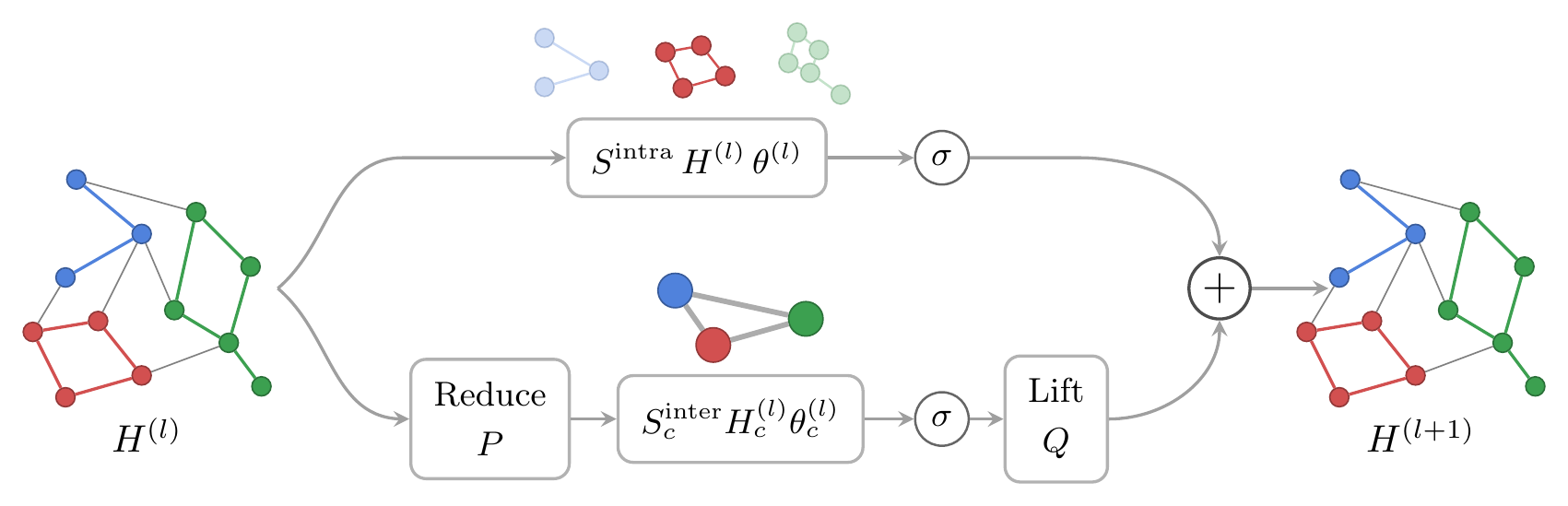
More recently, we proposed CoRe-GNN, a multilevel message passing on coarsened graphs. Each layer has two branches. The first passes messages inside each cluster, on the original graph; the second passes them between clusters, on the coarsened graph. This split gives a natural batching scheme: a batch keeps a few clusters at full resolution and sees the rest of the graph through the coarsened graph, so that GNN training scales to large graphs. I also released GraCo, an open-source toolkit that gathers 17 graph coarsening methods and the metrics of their papers behind one interface.
My main scientific interests include graph machine learning and more specifically machine learning on large graphs, though they are not limited to this area. I am also interested in frugality, and more recently, in flow matching and diffusion applied to graphs. If you’d like to chat or collaborate on any of these topics, feel free to reach out!
Outside of research, I enjoy discovering hidden gems for restaurants, tennis, bouldering, and wandering contemporary art museums (maybe one day I’ll share my Paris favorites…).
news
| Oct 31, 2026 | GraCo is out: an open-source toolkit of 17 graph coarsening methods and the metrics of their papers, behind one interface, with a companion preprint.  |
|---|---|
| Sep 21, 2026 | Poster of “Taxonomy of reduction matrices for Graph Coarsening” at GraphLearn 2, CIRM, Marseille.  |
| Aug 03, 2026 | New preprint with Nicolas Keriven and Aline Roumy: CoRe-GNN: Multilevel Message Passing on Coarsened Graphs.  |
| Jun 15, 2026 | Poster of “Taxonomy of reduction matrices for Graph Coarsening” at the Learning on Graphs Paris meetup. |
| May 22, 2026 | I gave a talk on graph coarsening for frugal graph neural networks at the Séminaire de Statistique des Doctorant·e·s de l’IRMAR, at ENSAI.  |
selected publications
- Advances in Neural Information Processing Systems, 2025
- Advances in Neural Information Processing Systems, 2024